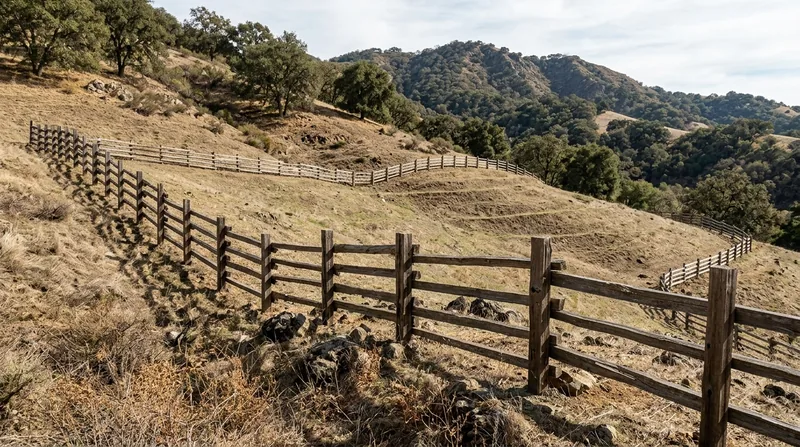




Farm fence installation in San Jose demands more than standard suburban techniques. The foothills terrain near Almaden swings between steep grade breaks and valley clay that expands when wet and shrinks when dry. Posts set on level ground won't hold on a 15-degree slope, and concrete footings tamped loose by seasonal swell fail within years. San Jose Fence Company has installed and repaired ranch and farm fencing since 2016 across Greater San Jose's variable topography, from the flat valley floor to the ridge lines where wind exposure accelerates wood aging. We set posts to hold on sloped ground and specify materials that endure the wet season's ground movement and the dry season's UV exposure.
Why Farm & Ranch Fencing Matters in San Jose's Foothills and Valley
Acreage in and around San Jose faces fencing challenges that subdivisions don't. Property lines often run across slopes where a standard vertical post won't work; fencing on unstable or clay-heavy soil requires deeper footings and concrete sets rather than tamped earth; and wind exposure in the hills ages uncoated wood and hastens rust on steel. A fence that holds for 15 years in the flatlands may fail in half that time on exposed acreage. Getting the post spacing, footing depth, and racked-versus-stepped installation right the first time saves thousands in premature replacement.
- Sloped terrain requires stepped or racked installation to keep the fence line plumb and the pickets or rails vertical.
- Post spacing on exposed acreage is tighter than on sheltered residential lots to resist wind sway and sag.
- Valley clay's seasonal swell and shrink works posts loose over time, so concrete footings set below the clay layer hold far longer than tamped installations.
- Wood species and coatings must tolerate San Jose's dry summers and wet winters, with coastal areas adding salt air exposure that accelerates decay.
- Split rail, pipe, no climb horse fence, and barbed wire installations each have specific code and material rules that vary by county and HOA.
Choosing the right method and material for your acreage prevents costly repairs and keeps livestock, property lines, and wind exposure managed from day one.
Key info: San Jose and Santa Clara County set setback, height, and material rules that apply to farm and ranch properties. Before ordering materials, verify requirements with your local building department or county agricultural extension. Some properties also fall under HOA deed restrictions that govern fence height and appearance even on acreage.
For detailed guidance on permit requirements and local fencing codes, consult the Santa Clara County government website, which publishes zoning and setback rules by jurisdiction.
How We Install Farm & Ranch Fencing on San Jose Acreage
Every acreage job starts with a site walk to assess slope, soil type, drainage, and wind exposure. We then locate utilities using California 811, mark the fence line from your existing survey or property stakes, and determine whether the installation will be stepped (each section level, with the fence line stepping up the slope) or racked (the fence face following the slope contour). Posts are set in concrete below the clay layer to resist seasonal swell, and post spacing is adjusted for terrain and wind load. Material choice, whether split rail, pipe, no climb mesh, or board, depends on your animals, budget, and local code.
- Confirm property lines from your survey and mark the fence line with spray paint or stakes.
- Call 811 for a free utility locate at least 48 hours before digging, as required by California law.
- Assess the slope and soil; determine whether installation will be stepped or racked.
- Dig post holes to a depth that places the footing below the active clay layer, typically 30 to 36 inches in San Jose valley clay.
- Set posts in concrete and allow 48 hours cure time before hanging rails or panels.
- Install rails, pickets, mesh, or board in the pattern specified for your application and animals.
- Install gates with self-closing, self-latching hardware if animal containment is the goal.
The entire process respects the terrain and the soil's seasonal behavior, so your fence stands for decades rather than years.
Local example: A property in Los Gatos with a 12-degree slope and clay-heavy soil required a stepped installation with posts set 36 inches deep in concrete. A no climb mesh was installed for horse containment, with 6-foot post spacing to resist wind load on the exposed ridge. Total: 420 linear feet, completed in 8 working days with zero post movement in the first two seasons.
If you're planning a larger project or need guidance on material choice for your animals and terrain, contact us for a free estimate.
Farm & Ranch Fencing Installation Methods: Stepped vs. Racked
| Approach | Description | Best for |
|---|---|---|
| Stepped Installation | Each section of fence is level, with the entire fence line stepping up or down the slope in discrete jumps. Posts remain vertical, and the fence face is always plumb. | Steep terrain, split rail and pipe fencing, areas where a clean aesthetic is important, and slopes over 20 degrees where racking creates large gaps at the base. |
| Racked Installation | The entire fence face follows the slope contour. Posts remain vertical, but the rails and pickets angle with the terrain, creating a smooth, flowing line. | Moderate slopes under 15 degrees, board and panel fencing, and properties where a continuous fence line is preferred over a stepped appearance. |
| Pipe Fencing | Steel pipe set in concrete with either stepped or racked configuration, typically 2-inch or 2.5-inch diameter galvanized or powder-coated. Extremely durable and low maintenance. | Horse and livestock containment, high-wind exposures, and properties where longevity and minimal repair are priorities. Common on San Jose foothills ranches. |
| No Climb Horse Fence | Vinyl or wire mesh installed on wooden or steel rails, with vertical spacing tight enough to prevent hooves from catching. Stepped or racked to follow terrain. | Horse pastures and mixed livestock areas where safety and visibility are essential. No climb mesh prevents hoof entrapment and reduces injury risk. |
| Split Rail Fencing | Rustic three- or four-rail design using cedar or pressure-treated pine logs. Typically stepped on slopes to maintain the aesthetic and structural integrity of the rails. | Rural and ranch properties, pastoral aesthetics, and areas where a traditional appearance complements the landscape. Requires post replacement every 12 to 15 years in wet climates. |
Farm & Ranch Fencing Cost in San Jose: What to Expect
Farm and ranch fencing costs vary widely based on terrain, material, and the complexity of the installation. Starting at $16 per linear foot, a basic split rail fence on level ground with post spacing of 8 feet can run lower; stepped installations on steep slopes, pipe fencing, and no climb mesh for horse containment typically range from $20 to $35 per linear foot depending on material grade, footing depth, and labor access. A 500-linear-foot property fence in the San Jose foothills with a 10-degree slope, concrete footings, and no climb mesh might total $8,000 to $12,000; the same fence on flat valley ground could run $7,000 to $10,000. Adding gates, auto-close hardware, or ornamental details raises the per-foot cost further.
Three factors move the price most: terrain (stepped or racked on slopes costs more than level ground), soil type (clay requiring deeper concrete footings costs more than sandy or loamy soil), and material (split rail is lower; no climb mesh with steel pipe is higher). Getting 2 to 3 estimates from local contractors lets you compare material choices and installation methods for your specific acreage.
For a detailed pricing breakdown tailored to your property and material choice, visit our pricing page or request a free estimate with photos or a site description.
Farm & Ranch Fencing Near Me: What San Jose Homeowners Should Know When Hiring
Choosing a contractor for acreage fencing in San Jose means verifying insurance, understanding how California's licensing requirement works, checking references, and confirming that the crew knows how to handle slope and seasonal soil movement. California requires a C-13 Fencing Contractor license for any project that reaches $1,000 in combined labor and materials or requires a building permit. That license is issued by the California Department of Consumer Affairs (CSLB) and is mandatory for professional fencing work. When you call a contractor, ask for their CSLB license number and verify it on the CSLB website; if they cannot provide one and the job scope requires a permit, the work is illegal in California.
Insurance and workers' compensation coverage are equally critical. A contractor working on your acreage should carry general liability and workers' compensation insurance; ask for a certificate of insurance naming your property. References matter: ask the contractor for three recent acreage or ranch projects in San Jose or nearby areas, and call those customers to ask about post stability, how the fence has held up in winter storms, and whether repairs have been needed. Finally, confirm that your property's HOA rules, deed restrictions, or county setback and height codes are understood before work begins. Many San Jose foothills properties have restrictions on fence height or material that are not obvious until a permit is applied for.
Contact us at (669) 274-3266 for a free, no-obligation estimate. We will assess your terrain, discuss material options, and provide a realistic timeline and price for your acreage fencing project.
Farm & Ranch Fencing in San Jose: Pricing Guide
| Service | Price | Details |
|---|---|---|
| Split Rail Fencing (Cedar or Pressure-Treated) | Starting at $16/ft | Three or four-rail rustic design on level ground with standard 8-foot post spacing and tamped footings. Stepped installation on slopes adds $2 to $4 per linear foot. |
| No Climb Horse Fence (Vinyl or Wire Mesh on Wood or Steel Rails) | Starting at $22/ft | Safety-rated mesh with wooden or steel rails, concrete footings, and 6-foot post spacing for wind resistance. Includes stepped or racked installation on terrain. |
| Pipe Fencing (2-Inch Galvanized or Powder-Coated Steel) | Starting at $28/ft | Durable steel pipe with concrete footings set below clay layer, 6-foot post spacing, and stepped or racked installation on slopes. Material and labor-intensive but lasts 30+ years. |
| Barbed Wire or Wire Fencing Installation | Starting at $12/ft | Wire strung on wooden posts with concrete footings, typically for livestock containment. Cost depends on wire gauge, post spacing, and terrain complexity. |
| Complex or Large-Scale Acreage Project | On estimate | Projects over 1,000 linear feet, steep slopes over 20 degrees, or requiring gate installation, utility locates, and permit coordination need an on-site assessment and detailed proposal. |
| Estimate and Site Visit | Free | No obligation. We assess terrain, soil, slope, and material options, then provide a detailed price and timeline. Call (669) 274-3266 for a response within 24 hours. |
Indicative pricing, the exact cost depends on square footage, finish, and site access. Free personalized estimate within 24h at (669) 274-3266.


